Communication, Conservation, Science

Bats, turtles and rowan trees

It’s been a while since the last update, but this doesn’t mean nothing has happened! Below, I give a short summary.

Rowan tree
First and foremost, I became a mom! Our little boy Rowan was born in March this year and we greatly enjoy his wonderful addition to our family.

Sea turtles
I was granted an NWO Open Competition grant to study the causes and functional consequences of sea turtle hybridisation in the Caribbean. I will work with a wonderful team of genomics and sea turtle experts. Why is this interesting?

Hybridization within sea turtles has been observed for over 130 years but its implications for their future are unsure. During hybridization two different species mate and their offspring receive a mixture of the parental species’ genes. This additional genetic variation could help the endangered turtles adapt to the changing environment. However, it could also affect their important roles within the ecosystem. We want to fill in those crucial knowledge gaps on sea turtle hybridization and contribute to making scientifically informed decisions on the conservation management strategies of sea turtles.

Methods in animal behaviour
With pleasure I contributed to a book on methods to study animal behaviour. In this book, we cover general principles, experimental design, how to quantify animal behaviour, potential biases to watch out for, technical tools one could use and a few basics in data analysis and presentation. Have a look!: Methods in Animal Behaviour | SpringerLink
Bat migration and exploration
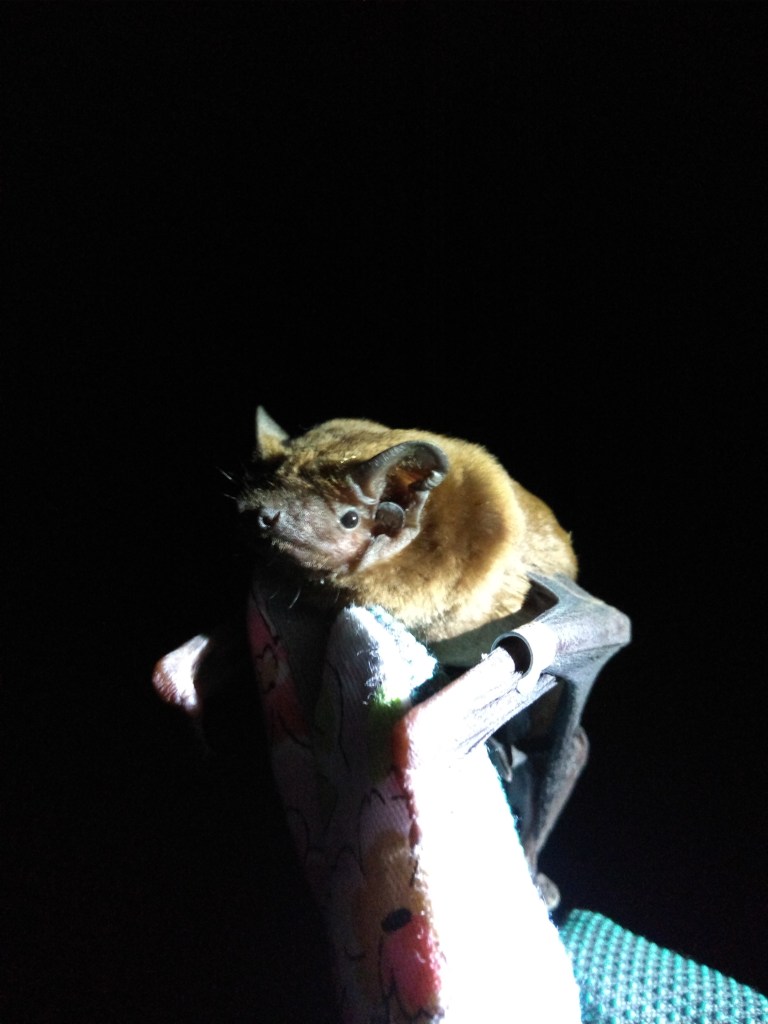
I published a new bat paper in the journal Behavioral Ecology & Sociobiology! I am very happy that this paper came out. It is based on my postdoc work at the Leibniz-IZW in Berlin. The amazing Theresa Schabacker is in the lead. Back then Theresa was my Master student and now she is leading her own PhD project on personality in tropical bats!

This paper examines partial migration & exploratory behaviour in noctule bats. Local bats were more likely than migrants to emerge into a novel environment, yet they did not differ in spatial & acoustic exploration activity. More info: Behavioral correlates of migration in bats – do migration strategies predict responses to a novel environment?

Lead author Bruce Yu on edge computing in wildlife ecology

Advances in wildlife behaviour and conservation
I co-authored a Forum and Opinion article in the journal Trends in Ecology & Evolution on novel technical developments in wildlife research and evidence synthesis for conservation.

Edge computing
“Modern sensor technologies increasingly enrich studies in wildlife behavior and ecology. However, constraints on weight, connectivity, energy and memory availability limit their implementation. With the advent of edge computing, there is increasing potential to mitigate these constraints, and drive major advancements in wildlife studies.” Check out more: Edge computing in wildlife behavior and ecology

AI in evidence synthesis
“Systematic evidence syntheses (systematic reviews and maps) summarize knowledge and are used to support decisions and policies in a variety of applied fields, from medicine and public health to biodiversity conservation. However, conducting these exercises in conservation is often expensive and slow, which can impede their use and hamper progress in addressing the current biodiversity crisis. With the explosive growth of large language models (LLMs) and other forms of artificial intelligence (AI), we discuss here the promise and perils associated with their use. We conclude that, when judiciously used, AI has the potential to speed up and hopefully improve the process of evidence synthesis, which can be particularly useful for underfunded applied fields, such as conservation science.” Check out more: Leveraging AI to improve evidence synthesis in conservation

Behaviour-based interventions for wolves
Master student Thaana van Dessel turned her impressive thesis into a scientific article for the journal Lutra. Through a meta-analysis, she evaluates the effectiveness of behaviour-based interventions in reducing livestock predation by wolves. Conclusion: “Overall, our results suggest that behaviour-based nonlethal measures could be a promising mitigation tool, provided that more research supports these findings. Therefore, we strongly recommend scientists, conservation practitioners and management authorities to collaborate and further research nonlethal interventions, especially investigating efficacy in real depredation scenarios. A more evidence-based approach to human-wolf conflict is essential in building a viable future for wolves, livestock and pastoral activities.”

Note
Above, you see a summary of everything that worked, but not all the things I tried/applied to/submitted that did not work or only worked after many tries. Please keep this in mind! And lots of interesting papers are still in progress, so stay tuned!

Science

Research overview 2022

It has been a bit quiet on my website, but this is not because nothing was happening. It has been a busy year with research, service, grant writing and education (more on that last point in another post). In this post, I want to give a short overview of some of the research I have been doing this year.

Publications

  • Smith B.P., Snijders L., Tobajas J., Whitehouse-Tedd K., van Bommel L., Pitcher B., St. Clair C.C., Appleby R.G., Jordan N., Greggor A.L. (in press). ‘Management techniques for deterring and repelling wildlife’ in Smith B.P., Waudby H., Alberthsen C. (eds) Ethical wildlife research in Australia. CSIRO Publishing, Melbourne, Australia. ISBN: 9781486313440

This book chapter provides general operating procedures (GOPs) and guidelines for a variety of non-lethal techniques, which seek to interrupt, reduce or modify the behaviour of wildlife to decrease the occurrence of ‘unwanted’ or ‘undesirable’ behaviours. 

  • Naguib M., Titulaer M., Waas J.R., van Oers K. Sprau P., Snijders L. (2022). Prior territorial responses and home range size predict territory defense in radio-tagged great tits. Behavioral Ecology and Sociobiology 76: 35. DOI: 10.1007/s00265-022-03143-3

The extent to which responses of a resident to a territorial intrusion predict its future responses is not well understood. In this study, we used wild great tits (Parus major) as a model species and revealed that home-range and spatial response, but not vocal response, predict future responses to simulated territory intrusions. 

  • Snijders L., Krause S., Tump A.N., Breuker M, Ramnarine I.W., Kurvers R.H.J.M., Krause J. (2022). Ephemeral Resource Availability Makes Wild Guppies More Social. BioRXiv. DOI: 10.1101/2022.05.20.492799

Resource availability and sociality are tightly coupled. Sociality facilitates resource access in a wide range of animal species. Simultaneously, resource availability may change sociality. We discovered that the presence of temporarily available food patches increases the sociality of wild guppies two-fold, even when the food was no longer present.

  • Kurvers R.H.J.M, & Snijders L. (2022). Group Size: The balance of the sexes. Elife, 11, e83254. DOI: 10.7554/eLife.83254

In this brief commentary, Ralf Kurvers and I respond to a recently published study on cooperation and competition as drivers of group size variation in ostriches. We highlight the relevance of this research and suggest interesting follow-up questions for future research.

Upcoming research highlights

Principal Investigator:

  • Exploration behaviour and partial migration in noctule bats (first draft finished)
  • Effectiveness of animal conditioning in mitigating human-wildlife conflict (data extraction stage)
  • Population differences in social foraging dynamics of wild guppies (data analysis stage)

Co-author:

  • Spatiotemporal responses of wild ungulates to hunting in a fenced multi-use area (first draft finished)
  • Behavioural indicators of bird flue in waterfowl (analysis finished)
  • Ecoacoustics: a biodiversity yardstick as a facilitating tool for nature-positive food production (funded)
  • Wildlife going to town: facilitating shared landscapes for humans and wildlife (funded – start 2023)

I look forward to sharing more details about these studies once they come out!

Conservation, Science

New publication: Conditioned taste aversion in human-wildlife conflicts

On the 13th of October, our review on an animal behaviour-based conservation intervention appeared online in Frontiers in Conservation Science. In this review, we visually, quantitatively and narratively synthesize the existing (English) evidence-base on the effectiveness of conditioned taste aversion (CTA) in human-wildlife conflict contexts. By evaluating this literature in the view of learning principles we were able to compose a decision-support table to guide future applications of this technique. Working with all coauthors for the first time, this project has taught me a lot about learning theory and the state-of-the-art application of it in conservation.

Modern wildlife management has dual mandates to reduce human-wildlife conflict (HWC) for burgeoning populations of people while supporting conservation of biodiversity and the ecosystem functions it affords. These opposing goals can sometimes be achieved with non-lethal intervention tools that promote coexistence between people and wildlife.

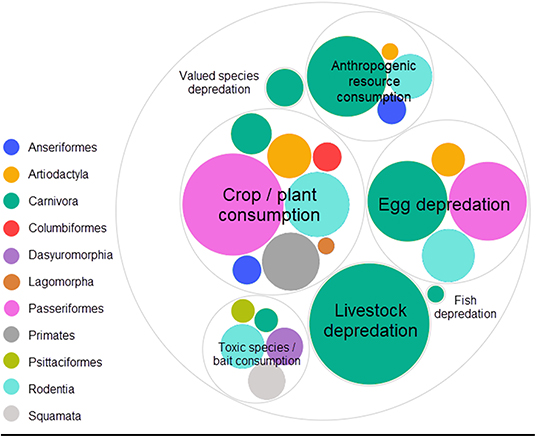
CTA has been applied to a wide range of animal taxa (57 (sub)species, 26 families and 11 orders)

One such tool is conditioned taste aversion (CTA), the application of an evolutionary relevant learning paradigm in which an animal associates a transitory illness to the taste, odor or other characteristic of a particular food item, resulting in a long-term change in its perception of palatability. Despite extensive support for the power of CTA in laboratory studies, field studies have exhibited mixed results, which erodes manager confidence in using this tool.

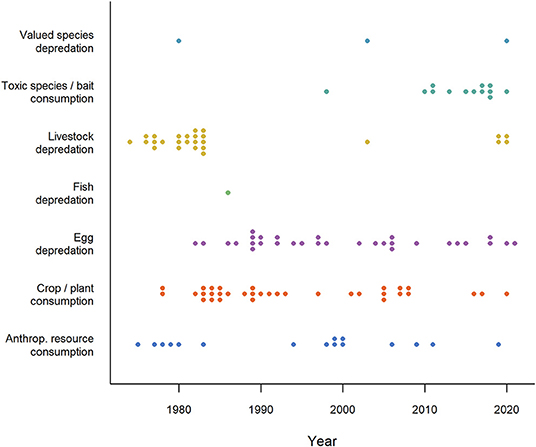
Application of CTA in various human-wildlife conflict categories across time

In this paper, we review the literature on CTA in the context of wildlife conservation and management and discuss how success could be increased with more use of learning theory related to CTA, particularly selective association, stimulus salience, stimulus generalization, and extinction of behavior. We apply learning theory to the chronological stages of CTA application in the field and illustrate them by synthesizing and reviewing past applications of CTA in HWC situations. Specifically, we discuss (1) when CTA is suitable, (2) how aversion can be most effectively (and safely) established, (3) how generalization of aversion from treated to untreated food can be stimulated and (4) how extinction of aversion can be avoided.

For each question, we offer specific implementation suggestions and methods for achieving them, which we summarize in a decision-support table that might be used by managers to guide their use of CTA across a range of contexts. Additionally, we highlight promising ideas that may further improve the effectiveness of CTA field applications in the future. With this review, we aspire to demonstrate the diverse past applications of CTA as a non-lethal tool in wildlife management and conservation and facilitate greater application and efficacy in the future.

Reference
Snijders, L., Thierij, N. M., Appleby, R., St Clair, C. C., & Tobajas, J. (2021) Conditioned taste aversion as a tool for mitigating human-wildlife conflicts. Frontiers in Conservation Science, 72: 744704

Science

New publication: Don’t forget about your friends

Remember those friends you never see anymore after they got hitched? Not in geese!

In our recently published paper, we show that barnacle geese keep hanging out with there favourite early-life social companions also after they pair up. Females show a break during the breeding season but display their social preferences again in the following winter. Males keep their prefered companions throughout the breeding and wintering season and these companionships were predicted by familiarity and genetic relatedness.

We also show that especially males were aggressive during the breeding season towards both males and females and this possibly hampered their female partners to hang out with their own ‘friends’ during breeding but not winter.

In summary, our study reveals the robustness of social preferences formed early in life, carrying over across pair formation, even after extended temporal disruptions. Our findings thus highlight how the early-life social environment can have life-long consequences on individuals’ social life, even in monogamous species.

Reference
RHJM Kurvers, L Prox, DR Farine, C Jongeling, L Snijders (2019)
Animal Behaviour 164: 25-37
Also as a preprint on BioRxiv